
Searching the St. Francis Court Docket
St. Francis has no dedicated docket portal or court counter of its own. The venue printed on the citation tells you where to go, whether that is a District Court department or Clay County Circuit Court. Search ARCourts makes a useful second check on the docket. Treat it as a backup, though, not as a reason to switch venues.
- Read the full court name, department, case number, and date on the papers.
- Choose Cases in Search ARCourts for a full number, or Participants for a name search.
- Filter to Clay County and the printed department where the portal permits it.
- Match the court, caption, status, and number before reading events.
- Call the assigned clerk to confirm the setting and request an official record.
Does a St. Francis result fail to appear? Strip the extra filters and double-check the court level. Some older or restricted cases simply do not surface online, and Search ARCourts is free but carries an unofficial label. For a certified docket sheet, ask the clerk of the court named on the papers. That office produces the record that counts.
No St. Francis Docket Department
The Arkansas Judiciary lists five departments for the Seventeenth District: Corning, Piggott, Rector, Paragould, and Marmaduke. Corning, Piggott, and Rector sit in Clay County. St. Francis is absent from the list, and that absence shapes every part of docket access here.
Do not invent a venue: a St. Francis address or city name does not select Corning, Piggott, or Rector. The St. Francis citation or clerk must identify the department.
Geography might tempt a resident toward the closest courthouse. The courts publish no allocation rule for St. Francis cases, so guessing is risky. A payment or record request sent to the wrong clerk can stall, and it does not satisfy a deadline set by another court.
St. Francis Municipal Court Basics
St. Francis has no municipal court of its own and no District Court department. Local citations move through the wider district structure, and the ticket itself names the venue. That assigned department keeps the docket. It handles a traffic, ordinance, or qualifying misdemeanor case, not some nonexistent city court.
Felony charges, general civil suits, domestic relations, probate, and juvenile matters all belong to Clay County Circuit Court. That court is part of the Second Judicial Circuit. So a St. Francis matter may land with a district department or with Circuit Court. The case header settles the question every time.
| St. Francis situation | First reliable clue | Custodian |
|---|---|---|
| Traffic or lower-level case | Department printed on citation | That District Clerk |
| Felony or general civil case | Circuit Court case header | Clay County Circuit Clerk |
| Unclear venue | County court contacts plus citation number | Clerk who confirms assignment |
St. Francis Citation Chooses Venue
A St. Francis citation should list the court, the alleged violation, a citation number, and appearance details. Those lines matter more than where the stop happened. Read every line before calling. If the department stays unclear, give the county court contact the full citation number and exact name, then ask which clerk owns the case.
Once you know the department, write it down. Reuse it for each St. Francis docket search, record request, payment question, or court-date check that follows. Another department's clerk may point a caller elsewhere. It cannot verify or alter a case held by a different court.
Court Dates and Settings in St. Francis
For a St. Francis date, start with the printed citation or the newest court notice. Search ARCourts may display a setting, yet past hearings stay in the event history after a reset. Work through every event posted after the original date. Then confirm the active setting with the assigned clerk.
| Date | The setting date shown by the assigned court, checked against later events. |
|---|---|
| Time | The local appearance time, which may be a group docket call. |
| Department | Corning, Piggott, Rector, or another court expressly named on the papers. |
| Location | The court's stated hearing site, not an assumed St. Francis building. |
| Setting type | Plea, arraignment, pretrial, motion, trial, sentencing, or review. |
Only the court grants a continuance; a phone request alone does nothing. Look for an order, reset event, new notice, or updated setting before treating the St. Francis date as changed.
St. Francis Docket Scale
St. Francis counted 218 residents in the 2020 Census. It is an incorporated place, but incorporation does not create a court department. The city posts no caseload figures, fine chart, court schedule, public terminal, or local docket website.
Those figures explain why a St. Francis search must route outward. They say nothing about how many citations or cases arise in the city.
Traffic Tickets in St. Francis
Arkansas CourtPay offers no Clay County, Corning, Piggott, or Rector option. It cannot tell you which department owns a St. Francis citation. Never test payment in a court the ticket does not name. Identify the assigned department first. Then ask its clerk. Ask about the active date, the total owed, plea options, authorized payment methods, and any appearance requirement.
Paying can enter a plea and waive trial rights. Anyone planning to contest a St. Francis citation should hold off on payment. The city publishes no fine schedule, deferred-disposition rule, defensive-driving policy, or online citation service. The assigned court's current instructions govern.
When the date is near: call the named department at once. A portal failure or venue guess does not excuse a missed appearance.
Finding the St. Francis Clerk
A smudged or torn citation is not a dead end. Start with the Clay County District Court contacts. Read off the full number. Piggott answers at 870-598-2265, Corning at 870-857-0115, and Rector at 870-595-9805. Treat these numbers as routing help, not as license to pick a venue.
- State that the matter arose in St. Francis.
- Read the court line and citation number exactly.
- Ask which department owns the case.
- Repeat the clerk's name, phone, and address back for accuracy.
- Ask what must be done before the printed appearance date.
Use mail, fax, or email only after the assigned St. Francis clerk supplies the exact payee, address, permitted document type, and deadline.
St. Francis Docket Routing Check
St. Francis has no city court, so a careful St. Francis docket search keeps the town's location apart from its legal venue. Two clues do the early work. The citation carries one. The St. Francis case header carries the other. From there, the assigned clerk can tell you whether the matter is active, closed, reset, or filed at another level. That settles the question for good.
Keep the St. Francis citation number in hand for every call. The same number drives the St. Francis portal search and any record request. If a clerk says the case sits elsewhere, get the full court and department name before you hang up. Writing that routing answer down protects you. It keeps a payment, plea, or copy request from landing at the wrong office in the St. Francis court docket system.
St. Francis Docket Search Fields
The statewide St. Francis docket search accepts participant names, an organization or case description, and a case number. Advanced controls can narrow a St. Francis result by court, case type, status, or filing period. Those options shift with the search context. Start broad, then add limits one at a time.
| Field | Best St. Francis use |
|---|---|
| Case number | Use the complete number from the citation or notice. |
| First and last name | Find a participant when the number is unknown. |
| Organization or description | Search a public body, business, estate, or case label. |
| Court filter | Match the department already confirmed for St. Francis. |
Let the St. Francis papers pick the department filter. Never use it to guess a venue.
St. Francis Docket Copy Request
Hold off on a St. Francis copy request until you know the court department. Once you do, give that clerk the citation or case number. Add the exact party spelling, a rough filing year, and the event or document title. A case-events list may suffice when the chronology is all you need. Name the citation, order, judgment, or motion when the filed paper itself matters.
St. Francis offers no mail-copy form, fee table, public terminal, or electronic request system. The clerk fills those gaps. Ask about inspection and whether the file is onsite. Ask also about plain and certified copy costs, accepted payment, and delivery options. Confirm the payee and amount before any funds move. Save the clerk's response with your request.
Where St. Francis Cases Go
A district case from St. Francis stays put. It remains with its assigned department until a valid appeal or other transfer occurs. A district judgment may be appealed to Clay County Circuit Court for trial de novo. Felony merits belong in Circuit Court. That rule holds even when the underlying event took place in St. Francis.
Docket flow: assigned District Court department › Clay County Circuit Court › Arkansas appellate courts
Federal cases run through an entirely separate court system. Clay County sits in the Eastern District of Arkansas, yet an ordinary St. Francis citation never turns federal just because no city court exists. Jurisdiction makes a case federal, not geography. The Eastern District court source matters only when federal jurisdiction and a federal case number are both present.
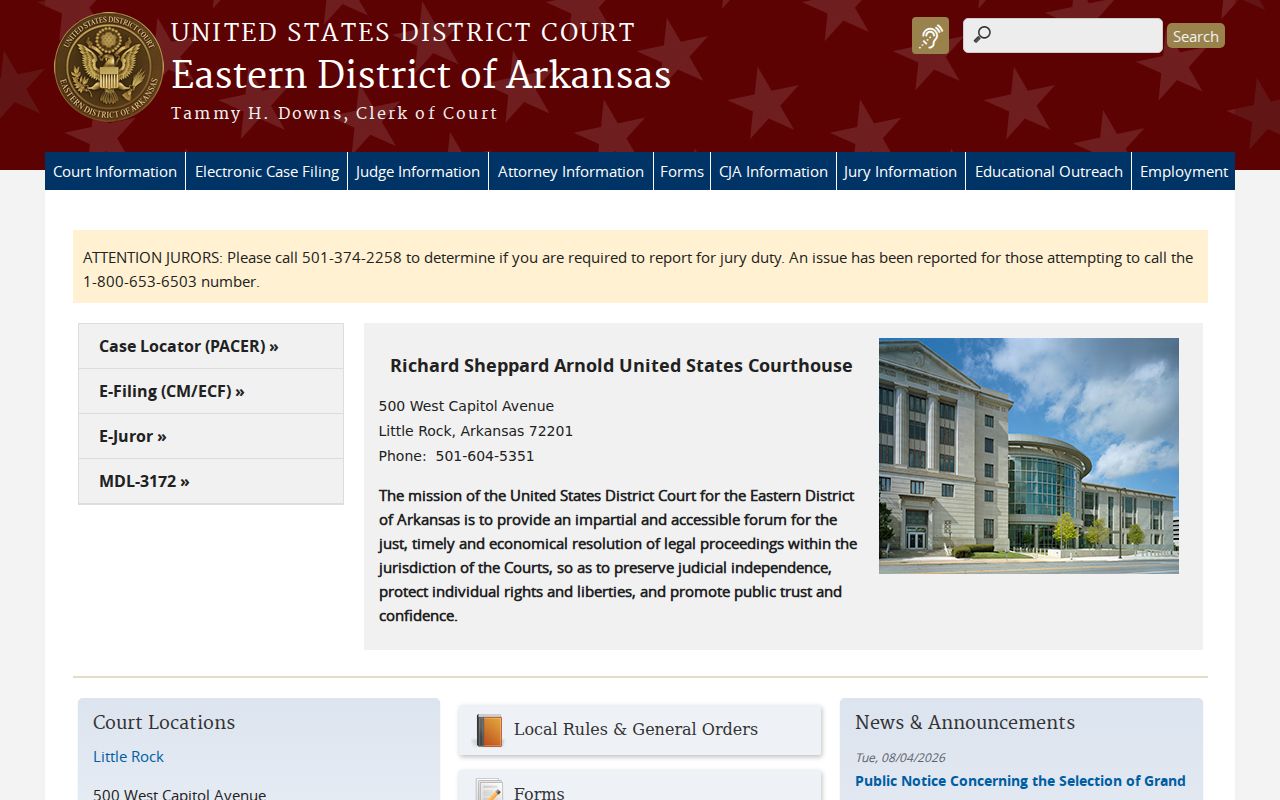
The federal route is separate. It is no fallback for a state or local St. Francis citation.
St. Francis Federal Docket Route
A true federal St. Francis matter is searched through PACER or the Eastern District's CM/ECF system. It never runs through Search ARCourts. The assigned division and the federal case number fix the hearing site. No federal courthouse stands in St. Francis. So confirm the court location. Do not infer it from the city. The official federal courthouse directory lists the Eastern District locations that do exist.
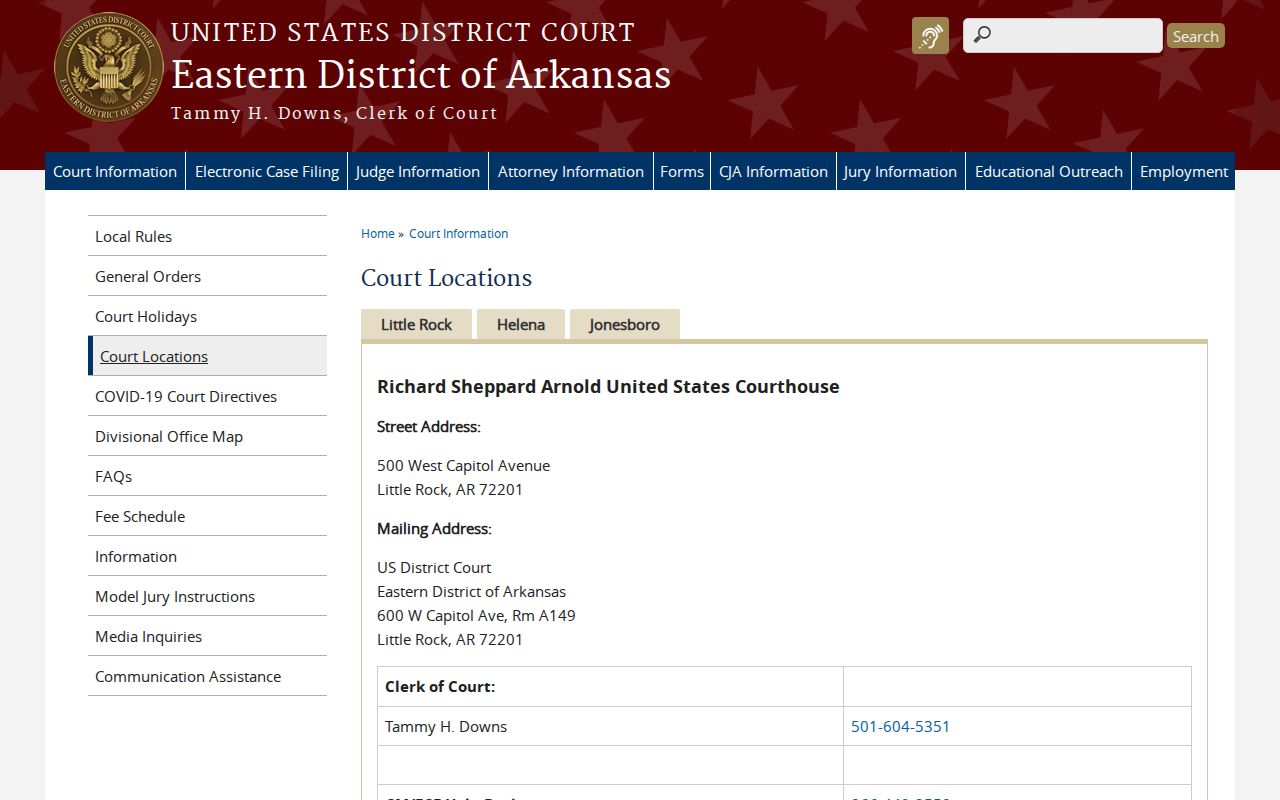
That directory serves only a federal St. Francis case. State Circuit and District Court records remain with Arkansas clerks.
Reading St. Francis Docket Results
A public case summary can show the number, caption, court, filing date, participants, charges or claims, events, settings, disposition, and some documents. The department field matters most in St. Francis. With no city court label to lean on, that field is your anchor in the court docket record.
- Case event
- A dated filing or court action in chronological order.
- Department
- The specific District Court office that owns the St. Francis matter.
- Reset
- A new setting posted after an older date.
- Certified docket sheet
- A clerk-authenticated list used when an official record is required.
A missing document link has several innocent explanations. The image may not be web-public, may be restricted, or may predate imaging. Ask the assigned clerk for the exact filing by title and event date.
St. Francis Court Record Access Rules
Public access to St. Francis court records is governed by Arkansas Supreme Court Administrative Order 19. Redaction follows Administrative Order 19.1. Juvenile, adoption, sealed, protected-identifier, and court-restricted content may not display at all. The Arkansas Freedom of Information Act cannot override these court rules. It cannot override a St. Francis sealing order either.
Right request, right clerk: public case information may be free online, but the clerk of the assigned court supplies an official St. Francis record.
Once the St. Francis venue is settled, ask its clerk about inspection, mail, phone, or an approved electronic route, and say whether you need a plain or certified copy. The clerk sets the terms. St. Francis posts no copy fee, counter hours, court building, or public terminal details, so confirm each one directly rather than guessing at a court record request.